


Along with the sighting, we enjoyed the beautiful landscape of Idaho.

We then moved on into Montana and our first stop was in Deer Lodge, MT. It was just an overnight stop however when we checked in to the park we saw some literature about the Grant-Kohr's Ranch Historical Site only about a mile down the road. Glenda needed her steps for the day and off we went.
Little did we know this was a very interesting site with a lot of history.
John Grant started using the Deer Lodge Valley in 1857 to graze his cattle during the winter along the banks of the Clark Fork river near Cottonwood creek. In 1859 he decided to permanently locate a ranch and constructed a permanent residence in 1862. He convinced traders to settle around him, forming the town of Cottonwood (later to become Deer Lodge). Johnny was initially successful, but found that when gold miners arrived in the area, he was at a disadvantage, because he spoke French and the newcomers spoke English. He was taken advantage of in contracts and felt that he could no longer be successful in the area. In August 1866, he sold his ranch to a cattle baron, Conrad Kohrs, for $19,200 and returned to Canada.
Conrad Kohrs was born on August 5, 1835, in Wewelsfleth, in Holstein province, which was then a part of the German Confederation. At the age of 22, he became a citizen of the United States. He went to California during the gold rush days. He then moved on to Canada and arrived at the gold camps of Montana in 1862. He never struck gold, but he became wealthy by selling beef to the miners. Kohrs built his cattle operation until he owned 50,000 head of cattle and had grazing pasture of 10 million acres (40,000 km2). However, he had a setback when the severe winter of 1886–1887 left over half the cattle population in the northwest dead. Most cattlemen went bankrupt, but Kohrs managed to receive a 100,000 dollar loan from his banker, A. J. Davis. While the open range era was ending, Kohrs adapted successfully and was able to pay off the loan in only four years.
Kohrs and his half-brother, John Bielenberg, turned to more modern methods of ranching, including buying purebred breeding stock, fencing his rangeland and raising and storing fodder. His became known as "Montana's Cattle King." Bielenberg helped Kohrs to run the Grant-Kohrs ranch. He originally came to Montana at age 18 in 1864 to help with the butcher shop that served the mining camps. Bielenberg had a lot to do with the horse side of the Grant-Kohrs ranch. He bred what were called the “Big Circle” horses, reputed to be able to cover twenty miles of country in a half a day; a trait useful when gathering cattle spread over a very large area. Together, Bielenberg and Kohrs made a most successful team for over half a century.
In August 1972, the U.S. Congress authorized the establishment of Grant-Kohrs Ranch National Historic Site to provide an understanding of the frontier cattle era of the Nation’s history, to preserve the Grant-Kohrs Ranch, and to interpret the nationally significant values thereof for the benefit and inspiration of future generations. In 1972 the National Park Foundation transferred ownership of its portions of the site to the National Park Service. Initially the site was administered under the jurisdiction of Yellowstone National Park. In 1972 the Grant-Kohrs Ranch National Historic Site was administratively listed on the National Register of Historic Places.
The ranch has several programs for kids. Like learning about the different type of animals in the area. The ranger showed us pellets from a wolf, fox, beaver, skunk and raccoon.

We also took a tour of the home that Grant built and later was added onto by Kohr's.
Unfortunately, like a lot of historical places where a fee is charged, they don't let you take photos inside. The interior of the home had several grandfather clocks, wallpaper on the walls and ceiling, ornate furniture with hand carving and carpet.

We walked around the grounds after the tour of the home and saw the blacksmith shop


The livery shed where they kept the horses and buggies.


We could have spent more time there but it was getting close to closing time for them and the weather was getting a little threatening. We got back to the park about 5-10 minutes before the skies opened up and the rain fell. We found out that there is so much history in the west and most people really down know about it. We sure didn't.
The next morning we headed further east to Three Forks, MT. Camp Three Forks is right off I 90. We got a nice partial shaded pull through. This park was an old KOA at one time and now converted. Our stay here was to help get us through the July 4th holiday. We wanted to be closer to Yellowstone but no openings until after the 4th. Still things to do around this area.


We did some research and found a State Park nearby called Madison Buffalo Jump SP.
The park is situated on the edge of a broad valley carved by the Madison River, this high limestone cliff was used by Native Americans for 2,000 years--ending as recently as 200 years ago. Native people stampeded vast herds of bison off this massive semicircular cliff, using them for food, clothing, shelter and provisions.
"Runners," highly skilled young men trained for speed and endurance, wore buffalo, antelope or wolf skins to lure bison to the "pishkun" or cliff. The buffalo jump was often the key to existence for native peoples. Although the introduction of horses led to the abandonment of this jump sometime after 1700, the rugged outcropping now serves as an inspiring monument to the region's early inhabitants.


The Buffalo Jump in the distance

Side view of the jump area

We had a great hike through the park and even found a geocache on one of the trails. Montana is a new state for finding caches too.
Down the road from our park is the Wheat Montana Bakery, right off I 90. This place is out in the middle of nowhere so to speak but people come from all over to get some bread and pastries there.
They also have a little deli and make sandwiches for lunch and dinner. Lots of different breads and souvenirs to buy. We stopped in one afternoon and I got a sandwich. Very tasty. Before we left I also got a couple of cinnamon rolls for future breakfasts.

We continued our exploring and found another State Park nearby. The Missouri Headwaters State Park. They have a bike path that goes from the State Park to Three Forks about 8 miles away. We didn't ride it but we did take a walk and got our steps in for the day. They have a campground there with no hook ups and we might have been able to get into a couple sites but not that appealing. Nice area to do some exploring. There were a couple of old buildings in the park. One was the remains of a hotel that someone tried to build thinking that they would be able to form a town there. But like a lot of old west areas if the trains didn't come through the town would die.


The next day we went into Three Forks and walked on the bike path from the town toward the State Park. There are a couple of small ponds and the Missouri River runs by it. There's a bridge across the river and some folks were tubing on the river.


The water looked a little cold but didn't seem to bother them. They were ready for a nice float.
On July 5th we had a reservation at Osen's RV Park in Livingston, MT. This stop would get us close enough to make a couple trips into Yellowstone NP. This is all new territory for us. We've heard so much about the geysers and animals that can be seen there. Well we were passing through so let's check it out.
The RV park is not far off I 90 and has decent access. The signs to go in were slightly confusing but we figured it out. The park has a lot of rules but not over done. Except the dump station of all places. They have a fence around it and you have to pull up to the office in the morning. (They don't open the dump station until 8:30 am) then they have someone escort you to the dump station, open the fence gate and help you dump. Never had that happen before in our 4 years on the road. Everything worked out fine though.
The sites are level with gravel and nicely spaced. We would come back again to stay to visit Yellowstone.
Our friends, Faye and Dave, had been to Yellowstone and told us we should get there early before the crowds so the next morning we got up about 6 am, got ready and headed to the park. IT's about an hour drive to get to the north entrance. Since we were staying at north of the park, it made sense to start that way.
The drive in was uneventful and we noticed there weren't as many people at the north end and in the park yet. Thank you Faye and Dave.
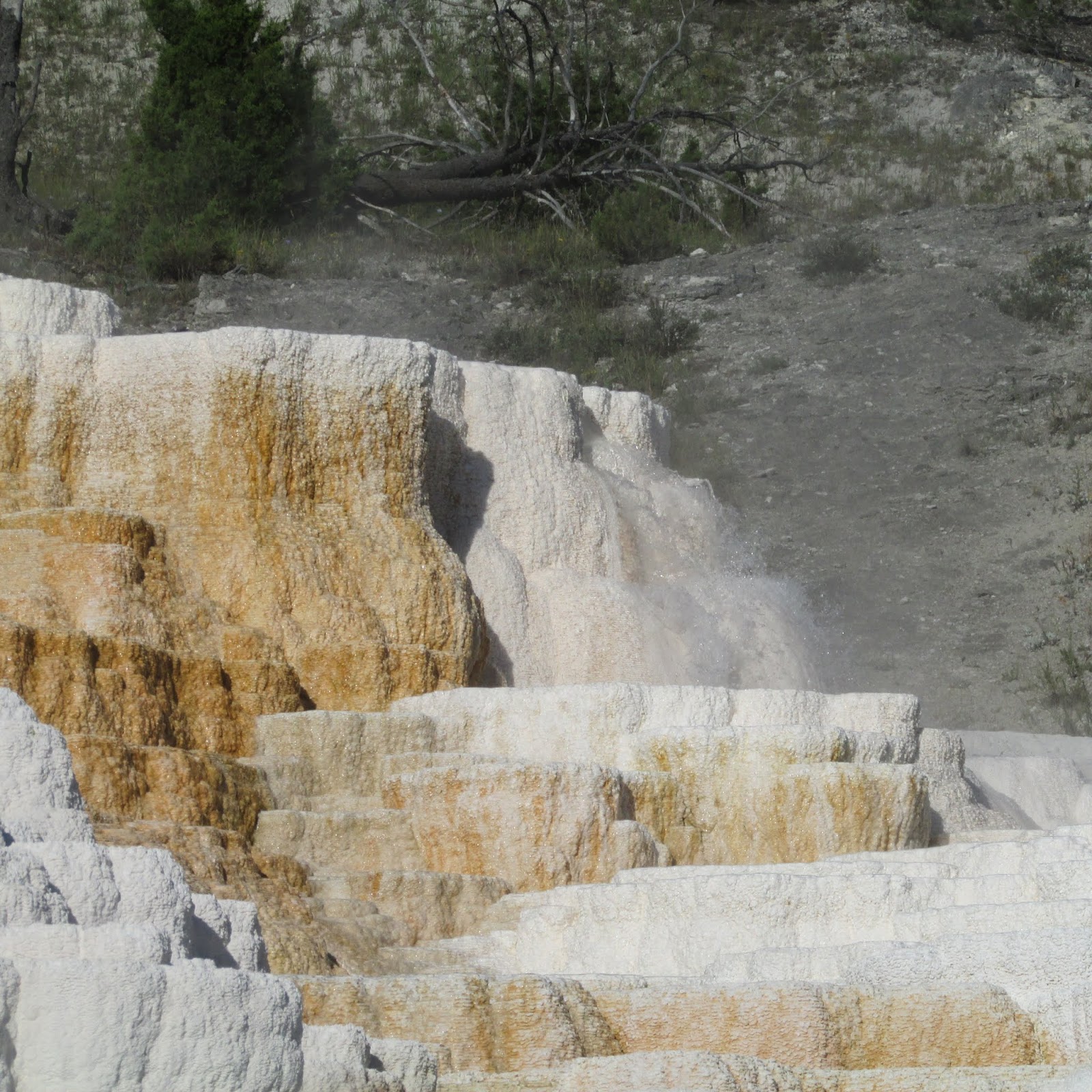
We stopped at the Mammoth Hot Springs first and I got my Passport for the National Parks stamped. The Hot Springs are amazing and very smelly. Like sulfur smell. You do get used to it. At the Visitor's Center there were several Elk paying next to the building. The rangers kept a watchful eye out and kept folks from getting too close.


It was about 8 am when we stopped at the actual Mammoth Hot Springs Terraces. When you first see them it looks like just one hot spring but there is an elaborate series of boardwalks around the springs that takes you to more and more terraces of bubbling sulfur hot springs. Many different colors and looks to the landscape. As we continued our walk around on the boardwalk the crowds began to emerge. It was about that time we had seen enough and time to move on.




One good thing we noticed was the north end of the park didn't seem as busy as we thought it would be. The roads were pretty much open related to traffic with only an occasional crowd of cars pulled over because someone thought they saw a bear or there was an osprey nest in the distance.
We gradually made our way to the Lamar Valley where there is supposed to be more wildlife. We weren't disappointed. Lots of bison and a few antelope.


This one was scratching itself on the wooden fencing
There's so much to see in Yellowstone and really shouldn't be done in one day. The park is so expansive and takes quite a while to explore just driving to the different locations. The park is just a huge bed of geysers and hot springs and geothermal activity. Everywhere you look there's something new to see.


We stopped in a parking lot to eat some lunch and had to eat in the car. The crowds were getting thick and it was hard to find an open picnic table in most areas as we traveled along the road. We enjoyed the scenery and landscape.
In the afternoon we came across the Firehole River Falls and stopped to enjoy the sound of the rushing water and he force of the water gushing down the canyon.


It had been a long day and time to head back to the RV park. We were going to come back the next day to see the west end and the more iconic features of the park. We also made plans to meet up with some friends we met at the RV Dreams Rally in Pahrump, NV in April. They're workamping at an RV park in West Yellowstone. More on that in the next post.
Well Glenda says let's not go back the way we came. We would have to go all the way back through the park to the north end again. She looked at the map and said this way should be shorter. She was talking about Highway 212 or the Bear Tooth Highway. It starts in Wyoming going out of Yellowstone, goes into Montana, back into Wyoming and then back into Montana. Little did we know what we were in for. If you've never been on this highway it twists and turns and goes up and down and then it climbs up, up, up over 11,000 feet. Turns out this was NOT a short cut home. But what an incredible detour. The landscape is breath taking and so picturesque. You can't help stopping multiple times to get new views, different views and spectacular views.
As we climbed to the summit, we could tell the road hadn't been open for a long time since there was still tons of snow along the road side. You could see where the plows has cut through the snow to open the road.


Above the tree line


That's a lot of snow


I don't know where this guy was going


As we drove on the highway we came across the Bear Tooth Lake before the road started to really climb higher. Just a few other folks there and a couple guys fishing for Brook Trout. The views there were also wonderful.


With the stops along the way and the stops for photo opts, we ended up not getting back home until after dark. But that's ok. We had a wonderful first day in Yellowstone. We head back tomorrow to see more of the iconic features of the park. I have a feeling it will be a little more crowded too.

Thanks for following along.


